
How spot, forward, and offtake models for carbon credits shape cost, risk, and your long-term climate strategy

Director of Sustainability Marketing
7 min read


Introduction
Whether you’ve been buying carbon credits for years or approaching your first purchase, recent and expected changes mean how you buy them is more important than ever.
The voluntary carbon market (VCM) has matured quickly. Buyers are expected to show not just good intentions, but a clear and effective strategy for buying carbon credits. That includes how they source credits, how they manage price exposure, and how they will ensure long-term access to high-quality supply.
The purchasing model you choose shapes all of this. This article breaks down the main carbon credit purchasing options available to businesses.
Why your carbon credit purchasing model choice affects risk
At a high level, how you approach buying carbon credits will determine your exposure to two core risks:
Supply security
As demand for high-quality carbon credits increases (particularly for carbon removals), the availability of these credits becomes less predictable. Some project types are already facing availability constraints, and future supply for the market will depend on how much capital is being invested, how quickly projects can be developed, and what signals the market receives from policymakers.
Price stability
Carbon credit prices vary widely depending on the type of project, the quality of the project, and what the broader market happens to be doing at the time. This means that buyers who enter the market without a structured approach can face significant cost volatility over time.
This is a challenge for sustainability leaders. They need to secure access to credible credits and ensure a stable supply over the long term, without locking up all their capital and while still maintaining some flexibility depending on where the market decides to go.
For CFOs, it raises questions about long-term cost exposure - will they be able to plan for price changes? Many companies do not fully understand the financial liability of a net-zero target that has not been properly costed out until the target date. Businesses that have not planned for the cost of their currently unfunded emissions reductions may struggle as target dates loom closer. Meanwhile, as carbon increasingly becomes a compliance concern, the cost of carbon pricing and even disclosure and reporting may be an unwelcome surprise for unprepared companies.
For procurement teams, carbon credits introduce a new category of sourcing complexity, because carbon credits behave very differently from traditional commodities.
This is why carbon credit procurement models matter. It’s not just about what price you end up paying. Getting your approach right can offer a strategic advantage, bringing down your risk, improving the credibility of your climate claims, and affecting your ability to execute a long-term climate plan.
What this means in practice
There are three primary carbon credit purchasing options that businesses use:
Spot purchases
Forward contracts
Offtake agreements
Each model offers a different balance of flexibility, price certainty, and long-term commitment.
1 - Carbon credit spot purchases
Spot purchases are the simplest way to buy carbon credits. You purchase credits that already exist and are available for immediate use.
This model is widely used by companies at earlier stages of their climate journey, or those looking to meet short-term needs.
Spot buying offers:
Immediate access to credits
High flexibility
Low upfront commitment
Ability to make claims about your climate action
However, there are a number of trade-offs with spot buying. It exposes you to current market pricing, which may mean you end up paying more than you need to. Credit availability is also limited to credits that have already been issued. This can make it harder to secure consistent access to high-quality credits over time.
Spot purchasing works best when used as part of a broader strategy, rather than as the sole approach.
2 - Carbon credit forward contracts
Carbon credit forward contracts allow you to agree today to buy a fixed number of credits at a certain price, on a certain date in the future.
This model introduces more structure. It allows you to effectively reserve future supply, often at a pre-agreed price or pricing mechanism.
Forward purchasing allows companies to demonstrate their climate leadership, but it also enables:
More price predictability
Improved supply security
Early access to developing projects
But it also requires more planning. You will need to assess project timelines, delivery risk, and your own future demand. This means stronger internal alignment between sustainability, finance, risk, and procurement teams.
Forward contracts are often used by companies that are scaling their carbon credit strategy and want to reduce exposure to future price increases.
3 - Carbon credit offtake agreements
Carbon credit offtake agreements represent the most long-term and committed approach.
In this model, a company agrees to purchase a significant portion of a project’s future credit output, often over multiple years. In some cases, this commitment helps enable the project to be carried out in the first place.
In practice, offtake agreements offer:
Strong supply security over the long term
Greater influence over project selection and design
The ability to support new climate solutions entering the market
They also require a high level of commitment. You are taking on delivery risk, long-term contractual obligations, and in some cases, exposure to changes in methodologies or standards.
Offtake agreements are most commonly used for carbon removal projects, where future supply is limited, and demand is expected to grow significantly.
They are a strategic tool for companies that are planning several years ahead and want to secure access to scarce, high-quality credits.
Carbon credit purchasing models exist on a spectrum (flexibility → certainty)
Spot | Forward | Offtake |
Low commitment | Medium commitment | High commitment |
Buy credits now | Buy credits later (agreed now) | Fund future project supply |
What you gain | What you gain | What you gain |
|
|
|
What you trade off | What you trade off | What you trade off |
|
|
|
How to decide between them
If you’re wondering how companies buy carbon credits in practice, the answer is usually a mix of these models.
The decision depends on four key factors.
Price
For many businesses, the straightforward cost of each option will play a major role in which way the business will decide to proceed.
There’s extremely little data out there to make direct comparisons between the prices of spot and offtakes, but in reviewing the data that does exist, we’ve been able to show that extant offtakes for nature-based projects - both removals (ARR) and high-quality avoidance (REDD+) - are already cheaper than the spot rates for the same projects. This means that entering into an offtake for these project types will save money right off the bat.
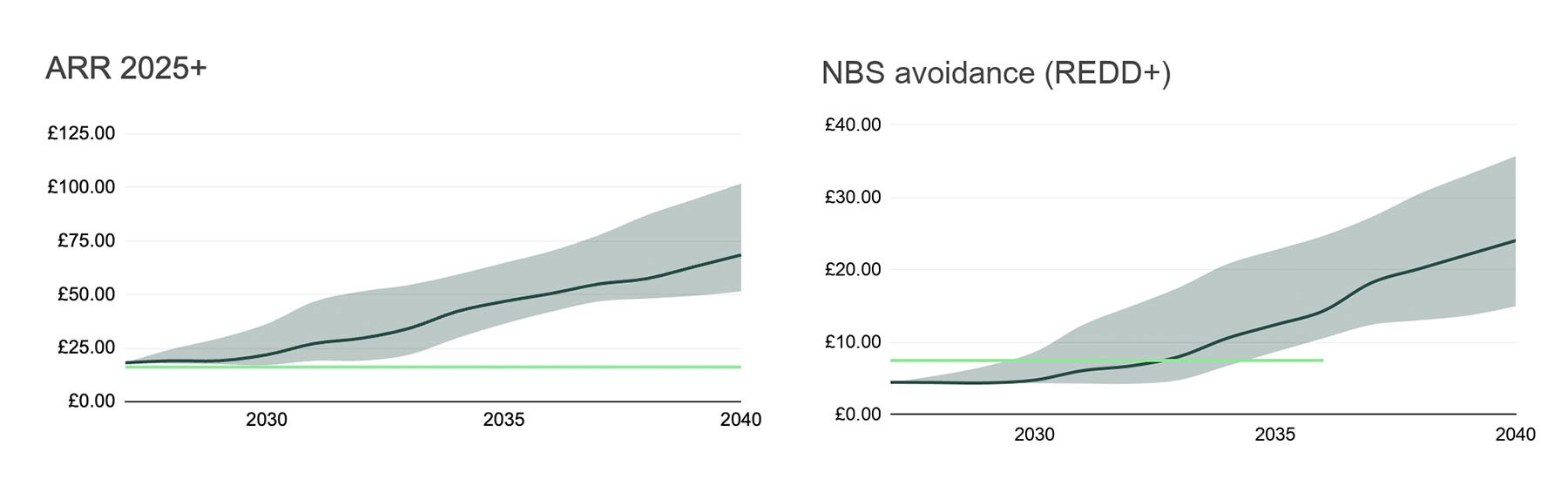
These charts show how spot prices for more recent vintages of ARR projects (left) and REDD+ projects (right) are expected to change over time. The shaded areas show the range of expected spot prices to 2040 based on data from AlliedOffsets. The light green lines show the average cost and duration of publicly-disclosed offtakes for these project types (adapted from data from AlliedOffsets and Sylvera) showing how offtakes allow buyers to secure cheaper pricing even when the spot prices are projected to increase. |
It’s harder to prove this for other project types due to the lack of publicly-disclosed data - but it’s a reasonable assumption that entering into long-term offtakes will allow greater leverage to negotiate cheaper unit prices for these project types as well.
And price isn’t the only factor…
Risk appetite
How much risk your organisation can tolerate will play a key role in your approach to purchasing carbon credits. If your priority is flexibility and minimal commitment, spot purchasing will feel more comfortable. It allows you to respond to changing internal priorities and market conditions.
If you are willing to take on more structured commitments in exchange for predictability, forward contracts might be more appealing. Or, if your strategy prioritises long-term certainty and access to high-quality supply (especially where removals credits are involved), you will likely need offtake agreements at some point.
This is often where cross-functional alignment becomes critical. Sustainability teams may prioritise impact and credibility, while finance teams focus on cost and risk. A clear internal position on risk appetite helps resolve these tensions.
Removal reliance
As your strategy evolves, you will likely need to incorporate more carbon removals, especially as you approach net zero. These credits are more capital-intensive, take longer to develop, and are currently in shorter supply in the VCM. Relying solely on spot purchasing is unlikely to be sufficient. You may struggle to access the volume and quality required.
Forward contracts and offtake agreements become increasingly important in this context, particularly for companies planning long-term carbon credit procurement. They allow you to secure access to removal credits before they are widely available on the market.
Long-term trajectory
Your purchasing approach should reflect where your organisation is heading, and not just where it is today. Early-stage buyers often start with spot purchases, but as your programme matures, a more structured approach becomes necessary.
This typically involves introducing forward purchasing to manage your price exposure and make sure you still have access to a supply of high-quality credits over the medium and long term.
Companies with established net-zero strategies, particularly those looking to align their carbon credit purchases with frameworks like the Oxford Principles, will likely find that long-term purchasing commitments make the most sense. Offtake agreements help companies manage their security of supply, but it also allows them to play a more consequential role in helping the carbon market develop.
Risks and common mistakes
While the three purchasing models are well established, how they are used can introduce significant risk.
1 - Relying on spot purchases long-term
While flexible, a spot-only approach exposes you to future supply constraints and price increases, often forcing reactive decisions that compromise cost or quality.
2 - Underestimating delivery risk in forward and offtake agreements
Projects can be delayed, underdeliver, or face regulatory challenges, especially in newer carbon removal markets, making robust due diligence and contingency planning essential. (We recommend working with a partner like Ecologi — our robust Carbon Project Assessment Framework offers a strong due diligence foundation.
3 - Misalignment with broader climate strategy
Purchasing decisions made in isolation can create issues, whether that’s overcommitting without clear emissions forecasts or buying low-quality credits that undermine credibility and increase greenwashing risk.
4 - Waiting too long to act
Delaying engagement with the market can mean you miss out on access to high-quality projects, pay higher prices in the future, and have less influence over project selection and portfolio design.
How to implement it
A structured approach to carbon credit procurement typically evolves over time.
Many companies buy carbon credits in phases:
1. Establish a baseline with spot purchasing
Start by engaging with the market and building an internal understanding of credit types, pricing, and what determines a project’s quality. Make spot purchases in the short term to meet your immediate needs, while developing a proper framework and governance processes for future purchases.
2. Introduce forward purchasing for predictability
As your strategy matures, start looking to the future and thinking about how you’ll secure a stable supply in the future. It’s not foolproof, but introducing some degree of forward purchasing can help smooth market price volatility and means your company can continue retiring credits at a consistent frequency even as market supply gets tighter.
3. Layer in offtake agreements for strategic supply
For companies with long-term commitments, particularly those planning for carbon removals, start looking at offtake agreements. As always, look for high-quality projects that align with your climate strategy and even your brand and business model.
4. Build a diversified portfolio
Avoid relying on a single purchasing model or project type. A balanced portfolio reduces risk and provides flexibility as the market evolves. For example, you could start to secure your durable removals for the years beyond 2035 with offtakes based on current projections of what you’ll need, and top-up any shortfall when each year comes around from the spot market.
5. Align with internal stakeholders
Make sure your sustainability, finance, procurement, and leadership teams are aligned on what they want to get out of your carbon credit purchases, how much risk they’re willing to tolerate, and the kind of timelines they’d like to see for credit delivery. Aligning on these elements is essential for making confident long-term commitments.
What this means for your carbon credit strategy
Choosing how to buy carbon credits is a core decision, and one that should be made thoughtfully, before any purchasing begins.
It determines how your organisation manages risk, secures supply, and positions itself in a rapidly evolving market. It also signals the level of maturity in your climate strategy.
The most effective approaches are intentional. They recognise that different purchasing models serve different purposes, and they use them in combination to balance flexibility with long-term certainty.
As the voluntary carbon market continues to develop, this balance will become more important. Companies that plan ahead, secure access to high-quality credits, and integrate purchasing into their broader strategy will be better positioned to deliver credible climate action.
If you are navigating these decisions, working with an experienced partner can help you move faster and with greater confidence.
Work with Ecologi on your carbon credit journey
Ecologi supports businesses across the full carbon credit journey, from strategy design to portfolio development and due diligence. Whether you are starting with spot purchases or exploring long-term offtake agreements, the right support ensures your approach is credible, aligned with best practice, and built to last.
Speak to one of our climate experts to explore how your organisation can build a carbon credit procurement strategy that works today and holds up over time.