Blog

How to develop a corporate carbon credit strategy

Climate Leadership

Science & Research

Policy & Compliance

Blog

How to develop a corporate carbon credit strategy

Climate Leadership

Science & Research

Policy & Compliance

From Risk to Reward: How UK businesses are building resilience to deliver long-term value

A step-by-step framework for building a credible, science-aligned carbon credit strategy–from first principles to long-term portfolio management.

Crista Buznea

Director of Sustainability Marketing

15 min read

From Risk to Reward: How UK businesses are building resilience to deliver long-term value

Introduction

If your company is buying carbon credits, whether for net-zero targets or broader sustainability goals, you need a corporate carbon credit strategy.

The voluntary carbon market is complex. Project quality varies widely, best practices are evolving, and scrutiny is only increasing. Without a structured carbon credit strategy, it’s easy to make decisions that appear credible but create real risk over time.

If your company is buying carbon credits, whether for net-zero targets or broader sustainability goals, you need a corporate carbon credit strategy.

The voluntary carbon market is complex. Project quality varies widely, best practices are evolving, and scrutiny is only increasing. Without a structured carbon credit strategy, it’s easy to make decisions that appear credible but create real risk over time.

Why structure matters

Why businesses need a corporate carbon credit strategy

Sustainability leaders are under pressure to deliver credible climate action while managing reputational and financial risk. A structured approach to carbon credit procurement helps achieve both objectives. It:

  • reduces the risk of greenwashing

  • ensures credits are used appropriately alongside emissions reductions

  • provides clarity across teams

  • supports long-term planning around cost and supply

For business leaders, this goes beyond sustainability. A clear carbon credit strategy strengthens positioning in tenders and customer conversations, aligns with investor expectations, and creates a more predictable approach to climate investment.

The benefits of a structured approach

A structured approach defines the role of credits within a broader climate strategy and transition plan, ensuring they address only residual or ongoing emissions rather than serving as a shortcut. It creates consistency, allowing teams to make decisions based on clear principles. And it builds in flexibility, so the strategy can evolve as standards tighten and the market moves toward higher-quality, more durable solutions.

This guide turns those principles into a practical nine-step framework, outlining how to develop a carbon credit strategy that stands up to scrutiny.

Why businesses need a corporate carbon credit strategy

Sustainability leaders are under pressure to deliver credible climate action while managing reputational and financial risk. A structured approach to carbon credit procurement helps achieve both objectives. It:

  • reduces the risk of greenwashing

  • ensures credits are used appropriately alongside emissions reductions

  • provides clarity across teams

  • supports long-term planning around cost and supply

For business leaders, this goes beyond sustainability. A clear carbon credit strategy strengthens positioning in tenders and customer conversations, aligns with investor expectations, and creates a more predictable approach to climate investment.

The benefits of a structured approach

A structured approach defines the role of credits within a broader climate strategy and transition plan, ensuring they address only residual or ongoing emissions rather than serving as a shortcut. It creates consistency, allowing teams to make decisions based on clear principles. And it builds in flexibility, so the strategy can evolve as standards tighten and the market moves toward higher-quality, more durable solutions.

This guide turns those principles into a practical nine-step framework, outlining how to develop a carbon credit strategy that stands up to scrutiny.

The 9-step carbon credit framework

This framework is designed to help businesses move from early-stage thinking to a fully-operational carbon credit strategy. Each step builds on the last, so don’t skip ahead. The sequence also reflects how carbon credits should sit within a broader sustainability strategy. They are not the starting point – they are introduced once your company has measured its emissions and made plans to reduce them.

What a corporate carbon credit strategy includes

A corporate carbon credit strategy should include:

  • why you’re buying carbon credits

  • how carbon credits fit alongside your emissions reduction plan

  • what claims you intend to make

  • how you will select, purchase, and manage projects

  • governance and how you will review and adjust as the market evolves

Step 1 - Understand your ‘why’

Why this matters for your business

Before you make any decisions about carbon credits, your company needs to be clear on one thing: why it is engaging in the carbon market at all.

A clear ‘why’ anchors your corporate carbon credit strategy in real business priorities. A compelling rationale will typically draw on some or all of these key elements:

  • Risk management
    A carbon credit strategy can help you manage climate risks across your operations, supply chain, and future regulation.

  • Stakeholder expectations
    Having a carbon credit strategy shows customers, investors, and employees that you’re taking real, credible climate action.

  • Commercial opportunity
    Carbon credit strategies give you an edge in tenders, sales, and brand positioning.

  • Climate contribution
    A carbon credit strategy lets you take responsibility for emissions you can’t yet eliminate while you keep decarbonising.

Step 2 - Review business risks and establish the business case for carbon credits

Climate change is already affecting operations, supply chains, reputation, and financial performance. A strong business case connects your carbon credit strategy directly to these risks, making it relevant to teams beyond sustainability.

There are five key areas to assess:

  1. Physical risk
    Exposure to extreme weather can disrupt operations, assets, and people.

  2. Regulatory and policy risk
    Evolving rules on emissions, disclosures, and carbon pricing, with penalties for inaction.

  3. Supply chain risk
    Climate impacts on the availability, cost, and reliability of key inputs and logistics.

  4. Brand and market risk
    Rising expectations for credible climate action, with reputational risk if claims fall short.

  5. Financial risk
    Poor sustainability performance can lead to increased costs, insurance pressures, reduced competitiveness, and restricted access to capital.

Carbon credits play a specific role here. They help address emissions that can’t yet be reduced, while contributing to broader climate action.

Step 3 - Integrate your carbon credit strategy into your emissions reduction plan from the start

One of the biggest mistakes businesses make is treating carbon credits as a separate activity from their internal sustainability initiatives. This often leads to over-reliance on credits or a last-minute, reactive approach. Best practice is to integrate carbon credits alongside your emissions reduction plan from the beginning.

At this stage, you need to align two parallel tracks:

  • Emissions reduction plan

    • Full measurement of emissions

    • Science-aligned reduction targets

    • Clear roadmap for operational and supply chain changes

  • Carbon credit strategy

    • Approach to addressing residual emissions

    • How contributions scale over time

    • Alignment with recognised best practice

Start with your emissions baseline, then define your reduction targets. Only then should you define the role of carbon credits to address emissions that cannot yet be eliminated and contribute to climate action outside of your value chain.

A simple way to frame this:

  • Reduce what you can

  • Restore and contribute for what remains

  • Report your progress


Step 4 - Identify carbon claims to target and the requirements of meeting them

Whether in reports, proposals, or marketing, what you say about your carbon credits will inevitably be scrutinised. Terms like “carbon neutral” or “net-zero” have specific requirements, and getting them wrong risks reputational and regulatory consequences.

At this stage, clarify what you want to say about your climate action. This might include:

  • No formal claims, but communicating contributions

  • Being “net-zero aligned” or on a pathway

  • Achieving “carbon neutral” status

  • Making product-level claims

Next, align your claims with recognised standards such as SBTi, VCMI, or ISO guidance. Claims should clearly reflect the role of carbon credits, avoid vague language, and be backed by appropriate evidence or verification.

Bring together sustainability, legal, and marketing teams early. Define:

  • What you’ll claim over time (and why)

  • What evidence is needed

  • What reporting and verification processes must be in place (either voluntarily, or based on regulatory requirements)

If a claim feels uncertain, it’s better not to make it. Clear, accurate communication builds trust and ensures your strategy stands up to scrutiny.

Step 5 - Design your intended carbon portfolio for today and into the future

A well-designed portfolio balances impact (climate, nature, and social), risk, and future trends. Companies that don’t take a portfolio view to carbon credit procurement often default to short-term transactional spot-purchasing (usually, whatever is most cost-effective at the time). It’s this kind of buying behaviour that can cause trouble for businesses down the track.

There are three key dimensions to consider when planning at the portfolio level:

  • Project type (avoidance or removal; nature-based or technology-based)

  • Durability (some projects store carbon temporarily; others offer long-term storage)

  • Co-benefits (some projects may support biodiversity or local communities)

The best approach (aligned with BVCM and Oxford Principles guidance) starts with a mixed portfolio that combines near-term impact projects with early investment in removals. Over time, the balance should shift toward higher-quality, more durable carbon removal.

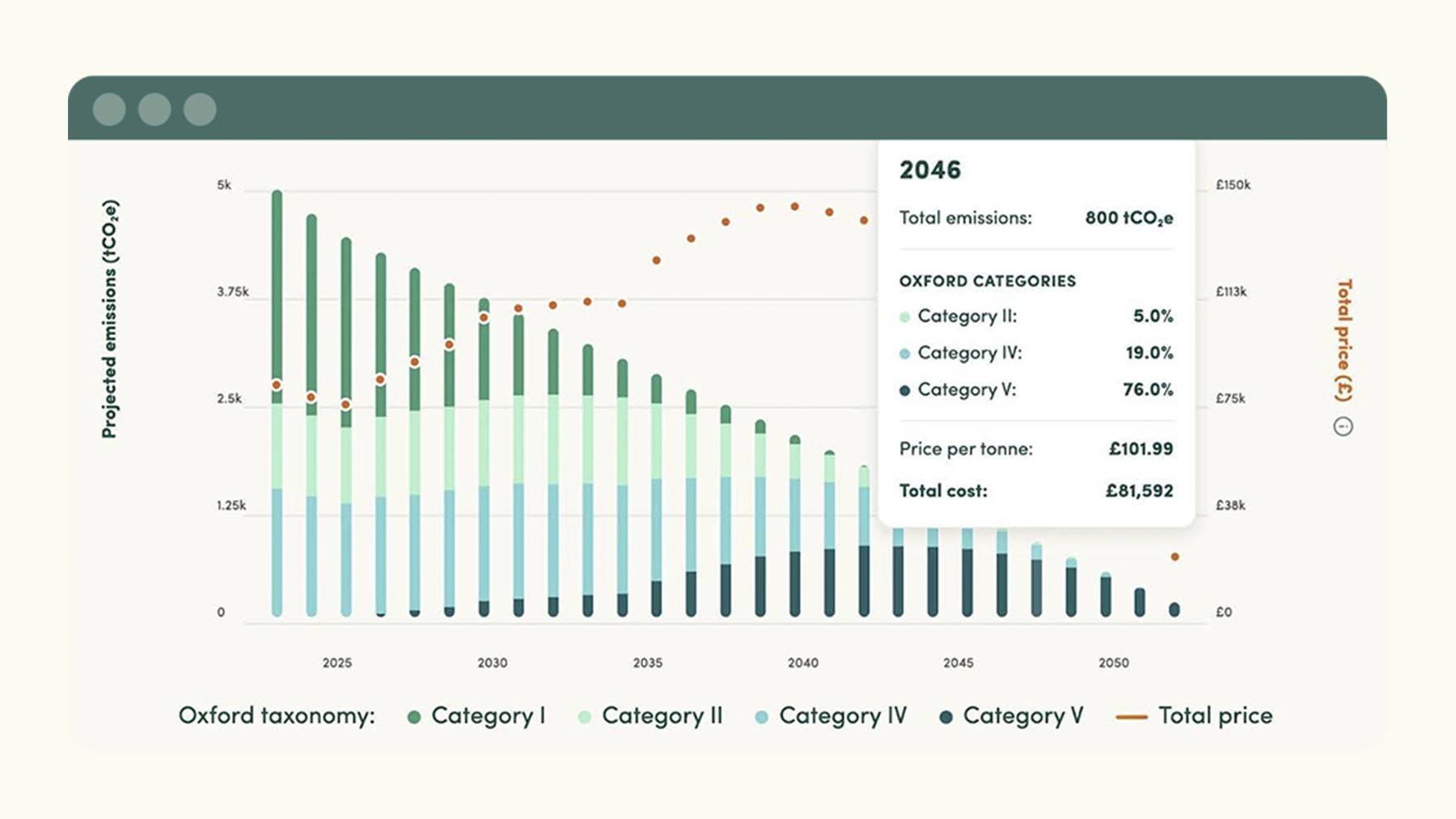
Here’s a visual example of Ecologi’s Oxford Principles-aligned portfolio breakdown by cost and project type over time:

A simple way to structure this approach over time:

  1. First, focus on near-term impact

  2. Then, transition into removals

  3. Create a long-term plan for investing in durable storage

This approach helps manage trade-offs, diversify risk, and anticipate where the market is heading.

Step 6 - Review and select high-quality projects

If portfolio design sets your direction, project selection determines whether your strategy actually delivers the impact you’re looking for. In the voluntary carbon market, quality varies widely, so choosing the right projects is critical to avoiding reputational risk and making a genuine climate impact.

What defines a high-quality carbon credit

High-quality carbon credits should meet a set of well-established integrity principles. These include:

  • Additionality – the project would not have happened without carbon finance

  • Permanence – the carbon benefit is durable and not easily reversed

  • Robust quantification – emissions reductions or removals are accurately measured

  • Independent verification – third parties validate and verify project performance

  • No double-counting – credits are only claimed once

  • Transparency and traceability – clear documentation and registry tracking

  • Wider impact – environmental and social co-benefits where relevant

How to assess project quality in practice

To assess project quality, you’ll need to look beyond surface claims. Projects should be evaluated across three layers:

  • Carbon standard – is it credible and well-governed?

  • Methodology – does the approach to measuring impact hold up?

  • Project design – how well is it implemented on the ground?

Tools such as our Carbon Projects Assessment Framework can be a useful starting point for evaluating carbon credits. Ratings agencies can also help compare projects, but they’re only part of the picture. The best approach combines third-party data with internal due diligence, including ongoing monitoring and risk management.

Key questions to ask:

  • How does the project assess and verify quality?

  • Does the project have credible evidence to support durability and impact?

  • How will the project manage risks over time?

For many businesses, this level of assessment may require specialist support through a partner you trust.

Project tracking

Pre-purchase evaluation is necessary for carbon credit purchases, but so is ongoing monitoring of projects. It’s important to continue monitoring your carbon projects, tracking any updates from ratings agencies or methodology revisions, or any news that may surface about the project.

If a project you hold is downgraded or faces credibility questions, you need to know early in order to act, which might involve seeking remediation, adjusting your portfolio, or updating your disclosures.

Step 7 - Select carbon credit purchasing options and enter contracts

Once you’ve designed your portfolio, the next step is determining how you’ll buy. Buying carbon credits is not a typical purchase – how you buy credits will affect how much you pay, how much risk you are exposed to, and whether you have access to high-quality supply over time.

There are three main options:

  • Spot purchases
    Buying credits that already exist. Simple and flexible, but often volatile in price and limited in access to top-tier projects.

  • Forward contracts
    Agreeing now to buy credits delivered later. Helps lock in pricing and secure supply, but carries delivery risk.

  • Offtake agreements
    Long-term commitments to future supply from a specific project. More strategic and can provide the enabling finance, especially for high-quality or emerging removals, but requires deeper due diligence.

We recommend using a mix of purchase types. Spot purchases can meet short-term needs, while forward or long-term offtake agreements help secure future supply and manage costs.

Before entering contracts, think about:

  • Pricing stability and exposure to volatility

  • Insurance in the event of delivery risk (if projects underperform)

  • Contract protections, such as replacement credits

  • Transparency around registry and credit retirement

In practice, align your purchasing mix with your broader strategy, and involve finance, legal, and procurement teams early. Set clear criteria for risk, approvals, and documentation.

Focusing on this step strengthens your strategy, helping you secure better projects, manage uncertainty, and stay ahead as the market evolves.

Step 8 - Communicate transparently and adhere to carbon claims best practice

Even a strong strategy can be undermined by poor communication. Stakeholders expect clarity, honesty, and consistency, and scrutiny is only increasing. Done well, communication builds trust and supports your brand. Done poorly, it creates confusion and greenwashing risk.

Transparent communication means being clear about what you’re doing and why. This includes:

  • Explaining the role of carbon credits in your strategy

  • Distinguishing between emissions reductions and external contributions

  • Sharing what projects you support and why

  • Clearly stating what claims you are making

Your messaging should align with the claims you defined in Step 4 and remain consistent across reports, marketing, and customer communications.

Key principles:

  • Use precise, simple language

  • Ensure alignment across sustainability, legal, and marketing teams

  • Back up claims with data and, where needed, verification

Build a clear communication framework with standardised language, approval processes, and consistent reporting. Avoid overstating impact or implying that credits “cancel out” or “offset” emissions. If a claim feels uncertain, it’s better to be conservative and transparent.

Step 9 - Continually review and evaluate progress

A carbon credit strategy is not something you set and forget. The market is evolving quickly, and your business will change too. Without regular review, even a strong approach can become outdated.

To stay on track, build a structured review process across four areas:

  • Emissions and reduction progress: Are you reducing emissions in line with targets? Has your trajectory changed?

  • Portfolio performance: Are projects delivering as expected? Are there new risks or quality concerns?

  • Market developments: Are standards, technologies, or expectations shifting?

  • Claims and communication: Are your claims still accurate and aligned with best practice?

In practice, this means setting clear ownership and a regular cadence:

  • Annual reviews to reassess strategy and portfolio direction

  • Quarterly or biannual check-ins to track progress and address issues

Tracking key metrics over time helps support better decisions and clearer reporting.

As market expectations move toward higher-quality credits, durable removals, and greater transparency, your strategy should evolve as well. Building in flexibility makes it easier to adapt without starting from scratch.

This framework is designed to help businesses move from early-stage thinking to a fully-operational carbon credit strategy. Each step builds on the last, so don’t skip ahead. The sequence also reflects how carbon credits should sit within a broader sustainability strategy. They are not the starting point – they are introduced once your company has measured its emissions and made plans to reduce them.

What a corporate carbon credit strategy includes

A corporate carbon credit strategy should include:

  • why you’re buying carbon credits

  • how carbon credits fit alongside your emissions reduction plan

  • what claims you intend to make

  • how you will select, purchase, and manage projects

  • governance and how you will review and adjust as the market evolves

Step 1 - Understand your ‘why’

Why this matters for your business

Before you make any decisions about carbon credits, your company needs to be clear on one thing: why it is engaging in the carbon market at all.

A clear ‘why’ anchors your corporate carbon credit strategy in real business priorities. A compelling rationale will typically draw on some or all of these key elements:

  • Risk management
    A carbon credit strategy can help you manage climate risks across your operations, supply chain, and future regulation.

  • Stakeholder expectations
    Having a carbon credit strategy shows customers, investors, and employees that you’re taking real, credible climate action.

  • Commercial opportunity
    Carbon credit strategies give you an edge in tenders, sales, and brand positioning.

  • Climate contribution
    A carbon credit strategy lets you take responsibility for emissions you can’t yet eliminate while you keep decarbonising.

Step 2 - Review business risks and establish the business case for carbon credits

Climate change is already affecting operations, supply chains, reputation, and financial performance. A strong business case connects your carbon credit strategy directly to these risks, making it relevant to teams beyond sustainability.

There are five key areas to assess:

  1. Physical risk
    Exposure to extreme weather can disrupt operations, assets, and people.

  2. Regulatory and policy risk
    Evolving rules on emissions, disclosures, and carbon pricing, with penalties for inaction.

  3. Supply chain risk
    Climate impacts on the availability, cost, and reliability of key inputs and logistics.

  4. Brand and market risk
    Rising expectations for credible climate action, with reputational risk if claims fall short.

  5. Financial risk
    Poor sustainability performance can lead to increased costs, insurance pressures, reduced competitiveness, and restricted access to capital.

Carbon credits play a specific role here. They help address emissions that can’t yet be reduced, while contributing to broader climate action.

Step 3 - Integrate your carbon credit strategy into your emissions reduction plan from the start

One of the biggest mistakes businesses make is treating carbon credits as a separate activity from their internal sustainability initiatives. This often leads to over-reliance on credits or a last-minute, reactive approach. Best practice is to integrate carbon credits alongside your emissions reduction plan from the beginning.

At this stage, you need to align two parallel tracks:

  • Emissions reduction plan

    • Full measurement of emissions

    • Science-aligned reduction targets

    • Clear roadmap for operational and supply chain changes

  • Carbon credit strategy

    • Approach to addressing residual emissions

    • How contributions scale over time

    • Alignment with recognised best practice

Start with your emissions baseline, then define your reduction targets. Only then should you define the role of carbon credits to address emissions that cannot yet be eliminated and contribute to climate action outside of your value chain.

A simple way to frame this:

  • Reduce what you can

  • Restore and contribute for what remains

  • Report your progress


Step 4 - Identify carbon claims to target and the requirements of meeting them

Whether in reports, proposals, or marketing, what you say about your carbon credits will inevitably be scrutinised. Terms like “carbon neutral” or “net-zero” have specific requirements, and getting them wrong risks reputational and regulatory consequences.

At this stage, clarify what you want to say about your climate action. This might include:

  • No formal claims, but communicating contributions

  • Being “net-zero aligned” or on a pathway

  • Achieving “carbon neutral” status

  • Making product-level claims

Next, align your claims with recognised standards such as SBTi, VCMI, or ISO guidance. Claims should clearly reflect the role of carbon credits, avoid vague language, and be backed by appropriate evidence or verification.

Bring together sustainability, legal, and marketing teams early. Define:

  • What you’ll claim over time (and why)

  • What evidence is needed

  • What reporting and verification processes must be in place (either voluntarily, or based on regulatory requirements)

If a claim feels uncertain, it’s better not to make it. Clear, accurate communication builds trust and ensures your strategy stands up to scrutiny.

Step 5 - Design your intended carbon portfolio for today and into the future

A well-designed portfolio balances impact (climate, nature, and social), risk, and future trends. Companies that don’t take a portfolio view to carbon credit procurement often default to short-term transactional spot-purchasing (usually, whatever is most cost-effective at the time). It’s this kind of buying behaviour that can cause trouble for businesses down the track.

There are three key dimensions to consider when planning at the portfolio level:

  • Project type (avoidance or removal; nature-based or technology-based)

  • Durability (some projects store carbon temporarily; others offer long-term storage)

  • Co-benefits (some projects may support biodiversity or local communities)

The best approach (aligned with BVCM and Oxford Principles guidance) starts with a mixed portfolio that combines near-term impact projects with early investment in removals. Over time, the balance should shift toward higher-quality, more durable carbon removal.

Here’s a visual example of Ecologi’s Oxford Principles-aligned portfolio breakdown by cost and project type over time:


A simple way to structure this approach over time:

  1. First, focus on near-term impact

  2. Then, transition into removals

  3. Create a long-term plan for investing in durable storage

This approach helps manage trade-offs, diversify risk, and anticipate where the market is heading.

Step 6 - Review and select high-quality projects

If portfolio design sets your direction, project selection determines whether your strategy actually delivers the impact you’re looking for. In the voluntary carbon market, quality varies widely, so choosing the right projects is critical to avoiding reputational risk and making a genuine climate impact.

What defines a high-quality carbon credit

High-quality carbon credits should meet a set of well-established integrity principles. These include:

  • Additionality – the project would not have happened without carbon finance

  • Permanence – the carbon benefit is durable and not easily reversed

  • Robust quantification – emissions reductions or removals are accurately measured

  • Independent verification – third parties validate and verify project performance

  • No double-counting – credits are only claimed once

  • Transparency and traceability – clear documentation and registry tracking

  • Wider impact – environmental and social co-benefits where relevant

How to assess project quality in practice

To assess project quality, you’ll need to look beyond surface claims. Projects should be evaluated across three layers:

  • Carbon standard – is it credible and well-governed?

  • Methodology – does the approach to measuring impact hold up?

  • Project design – how well is it implemented on the ground?

Tools such as our Carbon Projects Assessment Framework can be a useful starting point for evaluating carbon credits. Ratings agencies can also help compare projects, but they’re only part of the picture. The best approach combines third-party data with internal due diligence, including ongoing monitoring and risk management.

Key questions to ask:

  • How does the project assess and verify quality?

  • Does the project have credible evidence to support durability and impact?

  • How will the project manage risks over time?

For many businesses, this level of assessment may require specialist support through a partner you trust.

Project tracking

Pre-purchase evaluation is necessary for carbon credit purchases, but so is ongoing monitoring of projects. It’s important to continue monitoring your carbon projects, tracking any updates from ratings agencies or methodology revisions, or any news that may surface about the project.

If a project you hold is downgraded or faces credibility questions, you need to know early in order to act, which might involve seeking remediation, adjusting your portfolio, or updating your disclosures.

Step 7 - Select carbon credit purchasing options and enter contracts

Once you’ve designed your portfolio, the next step is determining how you’ll buy. Buying carbon credits is not a typical purchase – how you buy credits will affect how much you pay, how much risk you are exposed to, and whether you have access to high-quality supply over time.

There are three main options:

  • Spot purchases
    Buying credits that already exist. Simple and flexible, but often volatile in price and limited in access to top-tier projects.

  • Forward contracts
    Agreeing now to buy credits delivered later. Helps lock in pricing and secure supply, but carries delivery risk.

  • Offtake agreements
    Long-term commitments to future supply from a specific project. More strategic and can provide the enabling finance, especially for high-quality or emerging removals, but requires deeper due diligence.

We recommend using a mix of purchase types. Spot purchases can meet short-term needs, while forward or long-term offtake agreements help secure future supply and manage costs.

Before entering contracts, think about:

  • Pricing stability and exposure to volatility

  • Insurance in the event of delivery risk (if projects underperform)

  • Contract protections, such as replacement credits

  • Transparency around registry and credit retirement

In practice, align your purchasing mix with your broader strategy, and involve finance, legal, and procurement teams early. Set clear criteria for risk, approvals, and documentation.

Focusing on this step strengthens your strategy, helping you secure better projects, manage uncertainty, and stay ahead as the market evolves.

Step 8 - Communicate transparently and adhere to carbon claims best practice

Even a strong strategy can be undermined by poor communication. Stakeholders expect clarity, honesty, and consistency, and scrutiny is only increasing. Done well, communication builds trust and supports your brand. Done poorly, it creates confusion and greenwashing risk.

Transparent communication means being clear about what you’re doing and why. This includes:

  • Explaining the role of carbon credits in your strategy

  • Distinguishing between emissions reductions and external contributions

  • Sharing what projects you support and why

  • Clearly stating what claims you are making

Your messaging should align with the claims you defined in Step 4 and remain consistent across reports, marketing, and customer communications.

Key principles:

  • Use precise, simple language

  • Ensure alignment across sustainability, legal, and marketing teams

  • Back up claims with data and, where needed, verification

Build a clear communication framework with standardised language, approval processes, and consistent reporting. Avoid overstating impact or implying that credits “cancel out” or “offset” emissions. If a claim feels uncertain, it’s better to be conservative and transparent.

Step 9 - Continually review and evaluate progress

A carbon credit strategy is not something you set and forget. The market is evolving quickly, and your business will change too. Without regular review, even a strong approach can become outdated.

To stay on track, build a structured review process across four areas:

  • Emissions and reduction progress: Are you reducing emissions in line with targets? Has your trajectory changed?

  • Portfolio performance: Are projects delivering as expected? Are there new risks or quality concerns?

  • Market developments: Are standards, technologies, or expectations shifting?

  • Claims and communication: Are your claims still accurate and aligned with best practice?

In practice, this means setting clear ownership and a regular cadence:

  • Annual reviews to reassess strategy and portfolio direction

  • Quarterly or biannual check-ins to track progress and address issues

Tracking key metrics over time helps support better decisions and clearer reporting.

As market expectations move toward higher-quality credits, durable removals, and greater transparency, your strategy should evolve as well. Building in flexibility makes it easier to adapt without starting from scratch.

How to implement over 12–24 months

A phased approach makes carbon credit strategies practical and manageable. Most organisations move through three stages over 12–24 months.

Months 0–3: Establish foundations

Focus on alignment and clarity. Define your objectives, understand your emissions baseline, and get clear on how carbon credits fit alongside your reduction efforts. This stage should result in a clear strategy and an initial carbon budget.

Months 3–9: Design and pilot the strategy

Build and test your approach. Define your portfolio criteria and assess projects against this. Make your first purchases (we recommend doing this on a smaller scale or through short-term spot agreements). At the same time, build processes for procurement, governance, and reporting that can serve you over the medium and longer term.

Months 9–24: Scale and integrate

Expand and embed the strategy. Grow your portfolio over time, start to introduce longer-term agreements, and work on fully embedding carbon planning into financial decision-making. This is when communication about your credit purchase should become more consistent and outward-facing, supported by stronger reporting and stakeholder engagement.

By the end of this period, carbon credits should be fully integrated into your broader sustainability strategy and delivering real impact.

A phased approach makes carbon credit strategies practical and manageable. Most organisations move through three stages over 12–24 months.

Months 0–3: Establish foundations

Focus on alignment and clarity. Define your objectives, understand your emissions baseline, and get clear on how carbon credits fit alongside your reduction efforts. This stage should result in a clear strategy and an initial carbon budget.

Months 3–9: Design and pilot the strategy

Build and test your approach. Define your portfolio criteria and assess projects against this. Make your first purchases (we recommend doing this on a smaller scale or through short-term spot agreements). At the same time, build processes for procurement, governance, and reporting that can serve you over the medium and longer term.

Months 9–24: Scale and integrate

Expand and embed the strategy. Grow your portfolio over time, start to introduce longer-term agreements, and work on fully embedding carbon planning into financial decision-making. This is when communication about your credit purchase should become more consistent and outward-facing, supported by stronger reporting and stakeholder engagement.

By the end of this period, carbon credits should be fully integrated into your broader sustainability strategy and delivering real impact.

Governance and review cadence

Why governance matters

A carbon credit strategy spans multiple teams, so without clear governance, it can quickly become fragmented. Sustainability may lead the strategy, but finance controls budgets, procurement manages contracts, legal oversees risk, and marketing shapes external claims. Strong governance keeps these functions aligned, ensuring decisions are coordinated, accountable, and consistent.

What good governance looks like

At a minimum, good governance should define three things:

  • Ownership: Who is responsible for the strategy overall, and who owns specific components such as procurement, reporting, and communication

  • Decision-making authority: How decisions are made, approved, and escalated, particularly around project selection, purchasing, and claims

  • Cross-functional alignment: How sustainability, finance, legal, procurement, and marketing work together to implement the strategy consistently

In most organisations, sustainability leads the strategy, with structured input from other functions.

Establishing a review cadence

Governance is only effective if it is supported by a consistent review process. A typical cadence includes two layers.

→ Regular operational check-ins. These are usually quarterly or biannual and focus on tracking progress, monitoring purchases, and reviewing any immediate risks or issues.

→ Annual strategic reviews. These take a broader view, reassessing the overall strategy, portfolio composition, and alignment with evolving best practices and business priorities.

What should be reviewed regularly

Each review cycle should cover a consistent set of areas.

  • emissions performance and progress against reduction targets

  • carbon credit purchases, portfolio composition, and budget allocation

  • project performance and any emerging risks

  • alignment with current standards and market developments

  • accuracy and consistency of external communication and claims

Don’t skip this step – good governance strengthens credibility, improves decision-making, and keeps the strategy aligned as markets and priorities evolve.

Why governance matters

A carbon credit strategy spans multiple teams, so without clear governance, it can quickly become fragmented. Sustainability may lead the strategy, but finance controls budgets, procurement manages contracts, legal oversees risk, and marketing shapes external claims. Strong governance keeps these functions aligned, ensuring decisions are coordinated, accountable, and consistent.

What good governance looks like

At a minimum, good governance should define three things:

  • Ownership: Who is responsible for the strategy overall, and who owns specific components such as procurement, reporting, and communication

  • Decision-making authority: How decisions are made, approved, and escalated, particularly around project selection, purchasing, and claims

  • Cross-functional alignment: How sustainability, finance, legal, procurement, and marketing work together to implement the strategy consistently

In most organisations, sustainability leads the strategy, with structured input from other functions.

Establishing a review cadence

Governance is only effective if it is supported by a consistent review process. A typical cadence includes two layers.

→ Regular operational check-ins. These are usually quarterly or biannual and focus on tracking progress, monitoring purchases, and reviewing any immediate risks or issues.

→ Annual strategic reviews. These take a broader view, reassessing the overall strategy, portfolio composition, and alignment with evolving best practices and business priorities.

What should be reviewed regularly

Each review cycle should cover a consistent set of areas.

  • emissions performance and progress against reduction targets

  • carbon credit purchases, portfolio composition, and budget allocation

  • project performance and any emerging risks

  • alignment with current standards and market developments

  • accuracy and consistency of external communication and claims

Don’t skip this step – good governance strengthens credibility, improves decision-making, and keeps the strategy aligned as markets and priorities evolve.

Build a carbon credit strategy you can stand behind

Developing a credible carbon credit strategy takes time and expertise. It means navigating a market that is constantly changing, getting buy-in and alignment across many internal teams, and making decisions today that can hold up in the long term.

That’s where Ecologi comes in.

We help businesses turn best practice into a clear, actionable strategy – from defining your approach to building and managing a high-quality portfolio. Our team brings the expertise, due diligence, and market insight needed to reduce your risk and ensure your carbon credit strategy delivers real climate impact.

If you’re building or refining your carbon credit strategy, we can help you do it with confidence.

Speak to one of our climate experts to get started.

Developing a credible carbon credit strategy takes time and expertise. It means navigating a market that is constantly changing, getting buy-in and alignment across many internal teams, and making decisions today that can hold up in the long term.

That’s where Ecologi comes in.

We help businesses turn best practice into a clear, actionable strategy – from defining your approach to building and managing a high-quality portfolio. Our team brings the expertise, due diligence, and market insight needed to reduce your risk and ensure your carbon credit strategy delivers real climate impact.

If you’re building or refining your carbon credit strategy, we can help you do it with confidence.

Speak to one of our climate experts to get started.

Is your business ready
to take climate action?

If this article has inspired your business to start its climate journey, talk to our team today.

Is your business ready
to take climate action?

If this article has inspired your business to start its climate journey, talk to our team today.

Is your business ready
to take climate action?

If this article has inspired your business to start its climate journey, talk to our team today.